

Top Tips: Why Generating On-site Energy Makes Sense Following Covid-19

BasePower-TopTips_cover.gif

At the beginning of the year manufacturers were planning for the supply chain and labour challenges that might arise from Brexit. Fast forward three months, and this was eclipsed by the Covid-19 crisis. UK manufacturing now needs to weather the onset of a sharp, expected recession.  In this article we look at why generating your own on-site energy can help you to stay competitive and on top of changing regulations.


 1. Are you paying too much for your energy?  

The Covid-19 pandemic has caused dramatic changes in financial markets and lowering demand for commodities. This has resulted in the wholesale cost of natural gas falling to historic lows. For example, the day ahead price 12 months ago was around £12.63 /MWh whereas this week it reduced to £6.94/MWh. Yet, despite historic low gas and power prices, this is not necessarily passing through to actual invoices. Your electricity supply bill (and the electricity you use through the meter) is made up of several different costs. Only about 50-40% of the cost is the wholesale power price. The rest is made up of network and distribution costs and goes towards funding the Government’s renewable generation schemes. These costs are forecast to continue rising as UK energy evolves into a net-zero system.

 Manufacturers who generate their own energy requirements via an on-site Energy Centre (behind the meter) can avoid these costs. Combined Heat & Power (CHP) produces power and heat more cheaply than taking power through the meter and offers the added advantages of increased resilience and flexibility for the host site.


2. Fix your costs now to avoid increases later

 New regulation in the form of the Targeted Charging Review (TCR), will change the way that variable costs are applied to electricity supply bills. Charges that were once based on a time of use tariff (such as red band DUoS period between 4pm-7pm being more expensive or even the winter TRIAD charge), will instead be charged as a fixed flat rate, depending on your agreed capacity. This will affect the savings from load management, energy efficiency and on-site generation.

 TCR has now been delayed until 2022. As a result, fixing costs via a CHP scheme will guarantee a holiday of even cheaper heat and power before TCR begins. As BasePower fully-finances its energy projects, customers can expect a major share of energy savings which will go straight to the bottom line, without any requirement for capital expenditure. 


3. Re-use the heat for greater efficiencies. 

 The traditional process of sourcing power from the grid and heat from a boiler is around 50% efficient. CHP projects can increase overall efficiency to 80-90% with good heat use. This makes CHP particularly suitable for manufacturing processes that use a lot of heat. The heat byproduct from generation is captured and used around the factory for various processes. This efficient use of heat and power generation reduces the site’s overall energy costs. As much as 15% savings on annual energy spend can be achieved from a fully-funded BasePower project.


4. Integrate energy use with sustainability goals

 A well-engineered CHP project that recovers as much heat as possible reduces carbon emissions. This is good news for manufacturers who are looking to generate energy more sustainably.

 BasePower has helped automotive and food manufacturers to avoid the release of over 6 million kg of CO2 to the atmosphere since 2017. CHP projects also contribute to meeting Climate Change Agreements, whilst remaining competitive.


5. Get ready for net-zero

The Government has made a net-zero pledge by 2050. However, the exact fuels and technologies which will be used to achieve this ambitious goal is unclear. There will be a greater need for flexibility as carbon costs become material. CHP has the potential to use renewable fuels and can follow the decarbonising of the gas grid via utilising hydrogen and syngas.  

 With many lobbying groups calling on the Government to use the post COVID-19 rebuild to put a greener economy at the heart of policy-making, changes can be expected. Generating energy on-site through a CHP Energy Centre means you can reduce your costs now, stay competitive and remain fully flexible for whatever energy policy changes might lay ahead. By having an asset on-site like a CHP, you can be flexible in your demand and help your site and the UK along the path to net-zero.

 To find out how BasePower can help your business reduce energy spend and carbon emissions, contact us today.


BasePower Boosts Business Development and Operations

Ross cropped.png

BasePower has made a number of new appointments to the team as the company expands its roll out of energy centres across the UK.

Ross Winkworth, formerly of E.ON and RWE npower,  joins the company as Head of Business Development. He is an energy sales professional who will use his 14 years’ experience in the food and drink industry to help manufacturers understand their energy use and achieve their objectives of reducing cost and carbon emissions.

BasePower has also boosted its construction and operations teams as a result of new energy capacity being installed into manufacturing sites in the food, drink and automotive sectors.

Tomasz Jankowski joins BasePower as Project Manager. He is a qualified engineer who spent nine years working at E.ON in positions including Project Delivery Manager and Hvac Engineer. Miles Goor, who takes up the role of Project Engineer, completes the new line up. He is a mechanical engineer with project design and implementation experience gained in multiple roles in South Africa and the UK.  

Tomasz and Miles will work closely with BasePower’s existing team to ensure the successful development, procurement, construction and operation of world-class energy centres.


BasePower Expands Engineering and Operations Team

Serah cropped.png

Following the award of multiple Combined Heat and Power (CHP) contract wins, BasePower has appointed two highly experienced engineers to join its expanding team.

Serah Adegbenro is a Chartered Engineer with a 1st Class Master’s degree in Chemical Engineering. She has over a decade of experience in the food and pharmaceutical industries and comes to BasePower from the energy sector.  As Project Engineer, she is responsible for the growing portfolio of BasePower CHP energy centres across the UK, managing the construction process from design through to commissioning and full output.

Serah’s career includes eight years at Tate & Lyle where she was involved in the start-up and commissioning of a new cane sugar refinery in Egypt, was Technical Manager at a Liquid Sugar Plant in Israel, and managed engineering projects at Tate and Lyle sites within the UK. She was also a core part of a multi-million pound capacity expansion project at GlaxoSmithKline working on the manufacture of an Active Pharmaceutical Ingredient.

Cornerstoning BasePower’s engineering function is Dave Holden who joins the company as Operations Manager. Originally from the oil and gas industry, Dave trained as a Turbine Maintenance Engineer with GE. He comes to BasePower after 15 years’ experience of commissioning projects in the UK, Indonesia and offshore.

 Dave will work alongside the BasePower team to manage the technical development and construction of new CHP energy centres on client industrial sites. As projects pass through construction into completion, he will play a key role in ensuring a smooth transition of the projects into full operation and compliance with Health and Safety and Environmental regulations. 

“Serah and Dave bring a wealth of experience to the business and we welcome them to our rapidly expanding team,” said Robin Hardy, BasePower Projects Director.

University students visit automotive Energy Centre

POA student Day.jpg

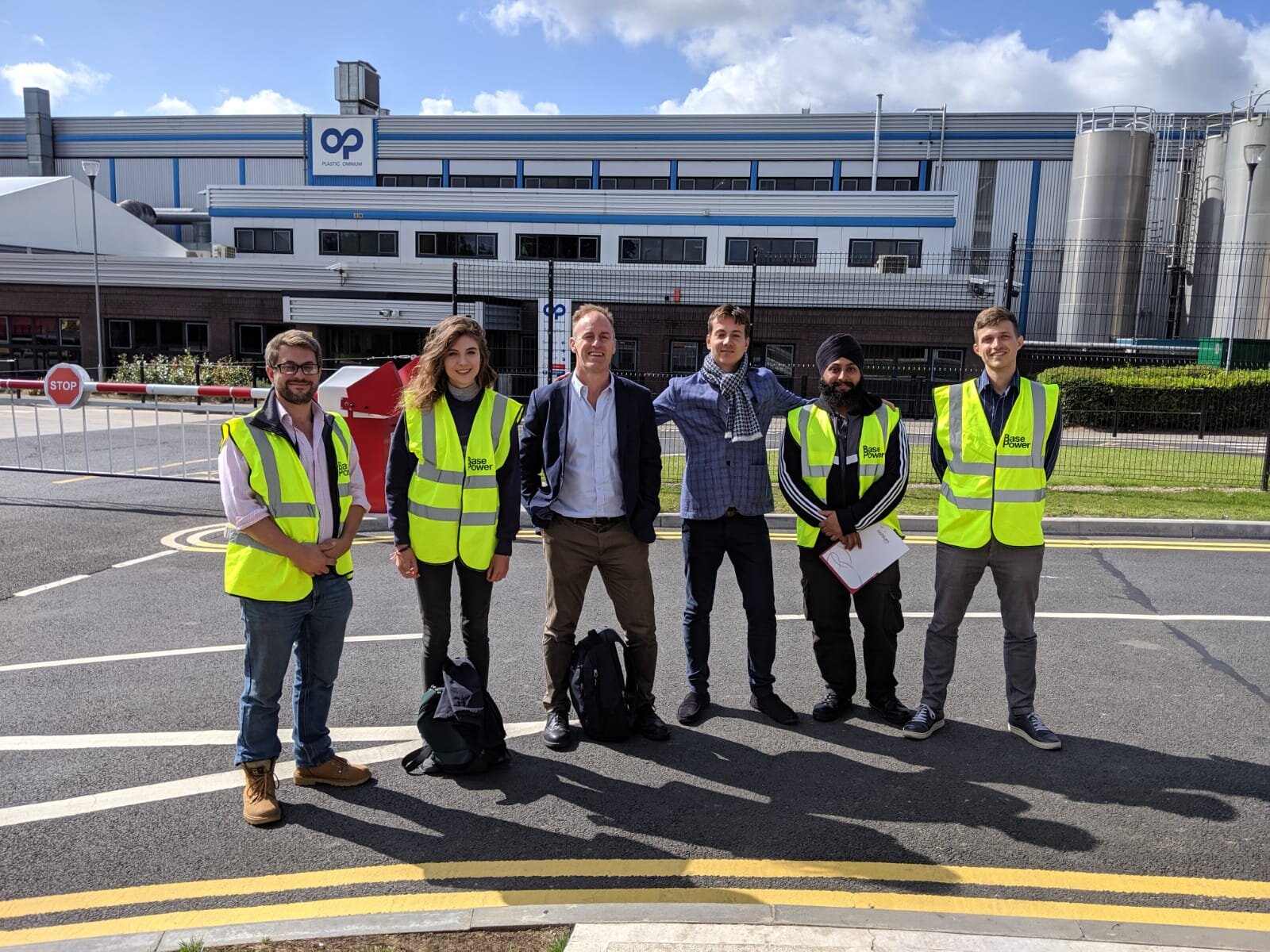
Engineering, Physics and Business students from universities in the UK and France recently spent the day at Plastic Omnium Automotive, Measham, learning about the opportunities for energy efficiency and carbon savings in the automotive industry.

The Plastic Omnium Energy Centre, built and operated by BasePower, is a 2MW Combined Heat and Power scheme which supplies a baseload of low-carbon electricity for use around the site, heat for the site’s paint shops, and process chill in the summer.

The students toured the Plastic Omnium factory and BasePower Energy Centre with Neil Champ, the site’s Engineering and Maintenance Manager. Neil gave them insights into the automotive industry borne of many years experience, and demonstrated how energy and carbon savings can be delivered through generating on-site energy.

 Robin Hardy, Projects Director, BasePower said:
“The students really valued the opportunity to see the scale of Plastic Omnium’s manufacturing operation and how it addresses energy savings opportunities. We greatly appreciate Neil Champ giving up his time to demonstrate how university learning translates into real-world activity.”

BasePower Expands: New Operations and Project Management Roles

BasePower is a rapidly growing, award-winning energy solutions company which designs, develops and builds Combined Heat and Power schemes for FTSE 250 clients in industrial sectors.

Due to the award of a number of new on-site energy contracts, the company is expanding and is recruiting for an experienced Operations Manager and CHP Project Manager to join the team.

Operations Manager
You will be responsible for the growing fleet of BasePower CHP installations across the UK. As our projects pass through construction into completion, you will play a key role to ensure a warm transition into full operation.

Reporting to the Director of Operations and Delivery, you will manage operational performance, budget, risks and opportunities to maximise the uptime of the installations for the client and BasePower. You will be responsible for ensuring compliance with Health and Safety and Environmental regulations, managing the project’s operational budget, analysing performance and resolving operational problems.

View the full job description, renumeration and package details.

CHP Project Manager
You will take ownership of the simultaneous delivery of multiple CHP installations across the UK. Reporting to the Director of Operations and Delivery, you will manage the programme, project budget, risks and opportunities in order to deliver projects on time and in line with the expectations of the client.

Through your technical understanding and experience in delivering process installation, you will develop and manage the construction process from design through to commissioning and full output including identifying and managing any operational issues.  You will be responsible for ensuring compliance with Health and Safety and CDM regulations, the management of sub-contractors across the disciplines of civils, mechanical, electricals and controls, as well as overseeing the training of site personnel and the handover to operations.

 View the full job description, renumeration and package details

If you are interested in applying for these roles, please contact Dan Robinson at Green Scout:
Email: dan@greenscout.co Tel: 01453 796 070 or 07557 346 110

Smart Energy: Insights from the ADE Conference

Screenshot 2019-07-01 15.10.32.png

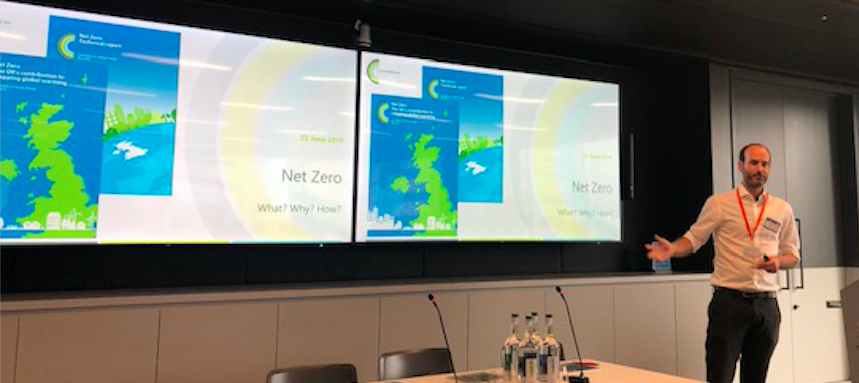
UK energy sector is breaking into uncharted territory as it is gradually shifting towards a fully decarbonised model.  Power, heat and transport, national systems to local systems, traditional and new assets, as well as innovators and suppliers are seeking to fulfil the potential of the UK’s “smart system” which will be required to deliver a decarbonised economy.

This formed the theme of the Association for Decentralised Energy (ADE) summer conference, which BasePower attended as an active ADE member. Last week, a groundbreaking law was passed in the House of Commons requiring the UK to achieve net zero carbon emissions in a thirty-year time frame. Mike Thompson of the Committee on Climate Change noted the symbolism of the UK being the birthplace of the Industrial Revolution in his keynote speech, which now has the most advanced climate change target in the world.

The recent report published by the Committee on Climate Change sets out the case for Government to realise this goal and reach net zero emissions by 2050. The UK recently ran without coal for two weeks, reflecting that 50% of its electricity supply is already from low carbon sources.  However, the supply of clean electricity needs to double and will require a combination of technologies including hydrogen power,, carbon capture and storage, heat pumps and battery storage, as well as significant investment and planning to deliver the ambitious target.   

How to Deliver Smart Energy

The conference featured a number of presentations on the innovations in smart systems that will be required to support the new energy landscape. One of the key developments is the increasing use of data to analyse and process energy demand and dispatch in real time. Joe McDonald from LimeJump, an aggregator and technology provider, described how they are currently managing Demand Side Response assets live and entering them in the energy markets; once it reaches a critical mass it may evolve to a full virtual market.

Andy McKay of Evergreen Smart Power, discussed the rapid take up of electric vehicles with a 30% growth rate expected within the next few years.  Smart charging will be required to cope with the expected post work surge.. Electric vehicles will also need to be vehicle-to-grid compliant but questions still remain on commercial arrangements for consumers and businesses sending power back to the grid. BasePower believes that CHP technology could play a key role at weaker parts of the electrical grid, which will help to support the roll out of electric vehicles.

 With 10,000 properties across the estate, TFL is the largest energy user in London. Alex Gilbert, TFL’s Senior Strategy Manager for Commercial Energy, shared some of its energy efficiency initiatives, which include the electrification of the entire network. He also shared how TFL is increasingly using renewables, using heat from CHP schemes and increasing its use of heat networks..

The Energy Systems Catapult is helping to deliver the UK’s objectives for the transformation of energy systems. There are a number of barriers that need to be addressed to deliver a more user-led energy system according to Guy Newey. He outlined their current project on decarbonising heating in the domestic markets. Their research is considering how householders could be incentivised to move away from conventional boilers to a heating model based on heating as a service model. Delivering a decarbonised economy and a net zero emissions will require fundamental changes to consumer habits, which are both complex and challenging.

 BasePower’s vision is that CHP will continue to be an important technology in industrial sectors and will play a more flexible role as the grid moves to a higher percentage of renewables. CHP schemes will be implemented as the initial core technology and then replaced with a more sustainable heat source at the end of their working lives.  

To find out how BasePower can help your business reduce energy spend and carbon emissions, contact us today.
 

BasePower Seeks Project Engineer

BasePower is an award-winning company with an innovative business model enabling large manufacturers to make a step-change reduction in energy costs and carbon emissions. We seek a Project Engineer to join our rapidly expanding company based in London Waterloo, which designs, builds and operates on-site energy generation schemes for FTSE 250 clients primarily in the automotive and food manufacturing sectors.

The Project Engineer will provide a critical role in supporting the BasePower team with the effective design and delivery of on-site energy projects. The ideal candidate will be a self-starter, with an Engineering-related degree and a minimum of 4 years experience gained within energy, manufacturing or a process industry. The role consists of the following key areas:

 Assessment

  • Visit BasePower’s manufacturing sites with commercial and technical colleagues and field technical queries

  • Capture relevant data during interviews with site employees and through site tours

  • Obtain and analyse further information through follow-up correspondence and calls

  • Model site energy loads and CHP production using company tools to assess project returns under various scenarios

  • Configure projects, contribute to studies and proposals, re-attend sites to present work and move the development forward.

Design and development

  • Write specifications for suppliers based on project requirements

  • Host site visits with suppliers and colleagues to resolve design options and de-risk projects

  • Engage with suppliers to identify potential cost savings

  • Run tenders for key project subsystems

  • Attend sites in a construction management or technical support capacity as required.


Required experience/skills

  • Engineering-related degree

  • 4+ years’ experience in energy, manufacturing or process industry

  • Experience in delivering engineering projects, ideally:

  • Identifying opportunities

  • Modelling financial returns 

  • Costing projects

  • Identifying stakeholders and assessing concerns

  • Procurement 

  • Project management and delivery

  • Commissioning 

  • Strong Excel and PowerPoint skills; Microsoft Project would be a plus.


Preferred experience/competencies

  • Experience of Combined Heat and Power or onsite generation

  • Process engineering experience

  • Electric engineering experience (High voltage would be useful)

  • Experience with industrial controls systems (software or hardware)         

  • Experience of using energy management systems.


BasePower is headquartered in a modern office space for the built environment sector and is situated minutes from London’s Waterloo station. The role is ideally suited to a self-starter who is comfortable with comparatively low levels of oversight, and seeks an opportunity to join a fast-growing company with an entrepreneurial culture. The position entails a mix of time in the office and travel to customer sites in the UK with an occasional overnight stay.

The salary package includes:

  • A competitive salary based on experience and a company bonus scheme

  • A programme of formal training and opportunities to study for third party qualifications

  • 25 days holiday

  • Relocation expenses

 Eligibility to work within the UK is required for candidates applying for the role.

To apply, please send your CV by email to info@basepower.com


The future of energy debated at Westminster seminar

ROBIN at WENG.jpg

Innovation and the future direction of the UK energy sector was recently debated at the Westminster Energy, Environment and Transport seminar, featuring keynote sessions and panels from a number of policymakers and stakeholders.

Chi Onwurah MP, Shadow Minister for Industrial Strategy, Science and Innovation, who opened the conference, argued that the UK should incorporate new innovations such as battery technology and energy from low carbon sources to help decarbonise the economy.

In his keynote speech, Matthew Billson, Head of Strategy - Energy Innovation Programme at BEIS said the UK leads the world in decoupling growth from emissions and the Government’s investment in energy is higher than ever before.  As a result, there is increasing innovation in commercialising new technologies which can play a key role in the UK’s aim to become a low carbon economy. The automotive sector is leading the way. Honda recently announced a partnership with UK battery technology firm Moixa to support the electrification of all its vehicles in Europe by 2025.  And earlier this year, Mitsubishi Corporation announced a 20 per cent stake in Ovo Energy, as it seeks a foothold in the digital energy transition.

Electricity Generation - the choices involved

Matthew Billson outlined the Clean Growth Strategy of 2017, which details the Government’s plans in response to the Climate Change Act. He discussed the allocation of a £505 million funding grant for the Energy Innovation Programme as part of the Government’s aim to accelerate the commercialisation of cheap, clean and reliable energy technologies by the 2020s.

 The primary technologies and their relative merits are:

·       £180m – Nuclear
Almost free from CO2 emissions but costly, difficult to tweak the output and process the resultant waste.

·       £15m - Renewables
Emissions free, also costly, not dispatchable and requiring plenty of space.

 ·       £100m - CCS and industry.
Support for industrial energy efficiency is welcome but large-scale CO2 capture and storage remains tied to depository locations off shore for further fossil fuel extraction.

·       £90m – Built Environment
The UK’s building stock needs significant investment to reduce our domestic and commercial heating demand.

·       £70m - Smart systems
More flexibility will be required from the grid as the % of renewables on the grid increases. 

The opportunities of battery storage to support our future energy systems was one of the clear themes of the day.  Energy from renewable sources has grown considerably but grid storage is still needed to smooth out the supply of renewables when the wind isn’t blowing and the sun isn’t shining. Significant progress has been made in the short-term battery sector (sub 4 hours capacity) over the last few years to provide grid services and support during times of strain, but longer term storage systems require more development.

Neil Morris of the Faraday Institution argued that the UK leads in vehicle electrification, as evidenced in London’s growing fleet of electrified buses and taxis. Although only 10% of cars are currently electric the target is to reach 100% by 2040 so there is huge potential for growth.

Funding is to be allocated to the Built Environment to decarbonise buildings, including the roll out of smart meters, use of big data and smart systems such as demand side response and vehicle to grid.

Hydrogen energy was increasingly talked about as a clean energy source for the future but there were lots of questions from the floor about the lack of a governing policy framework and the costs of production, which is still more expensive than other fuels. Generating hydrogen from excess renewable electricity at night is being explored alongside steam reformation of methane and the subsequent carbon capture of the CO2.

The role of CHP in a decarbonised economy

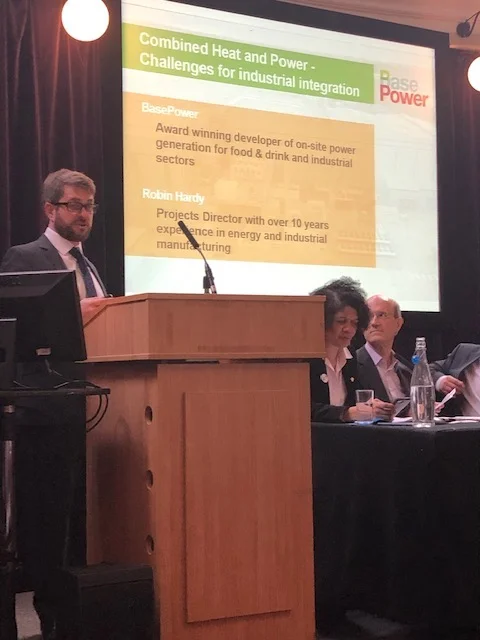
Robin Hardy, BasePower’s Projects Director, presented a session on Combined Heat and Power (CHP), which is becoming increasingly adopted by industrial users with a high electrical and heat demand such as food and automotive manufacturers.  He explained how CHP can be over 80% efficient if waste heat is captured and used to offset the use of additional fuel for manufacturing processes.  Heavy energy users who install CHP schemes can significantly reduce their energy costs and carbon emissions.

Robin covered some of the challenges to implementing CHP schemes including addressing the different needs of stakeholders and the complexity associated with connecting to the increasingly congested electrical grid. BasePower has found the gas network to be more resilient and less of a project constraint than the electrical network.

From a regulatory point of view we have found that it pays off to engage early with planning and environmental offices to allay any concerns prior to development starting. Containerising the schemes has often helped our projects proceed under permitted development.

Robin finished by demonstrating how CHP can play a more flexible role as the grid moves to a higher % renewables and how the technology can also play a role in helping the roll out of electric vehicles at weaker parts of the electrical grid.

During the follow up questions Robin discussed the model of sharing the heat from industrially led schemes to neighbouring commercial and residential properties. BasePower’s vision is that long lasting heating networks can be pioneered with CHP as the initial core technology but then replaced with the a more sustainable heat source at the end of its working life.

According to a recent think tank report, Britain must completely decarbonise in the coming three decades if the country is to meet its long-term climate change objectives. The Westminster Forum seminar demonstrated evidence of real technical innovation within the industry and the speakers declared that collaboration is vital between the various suppliers and the stakeholders for it to succeed. However there is still a long way to go.


BasePower to speak at Westminster Energy, Environment & Transport Forum

Westminster Forum.png

BasePower’s Robin Hardy has been invited to speak alongside a number of experts from the energy sector at the Westminster Energy, Environment & Transport Forum Keynote Seminar.

“Priorities for UK energy innovation: funding, commercialisation and collaboration,” will bring together policymakers and key stakeholders to discuss innovation and future direction in the UK energy sector. Chaired by Chi Onwurah MP, Shadow Minister for Industrial Strategy, Science and Innovation, the line up includes a keynote speech from Matthew Billson, Head of Strategy - Energy Innovation Programme, at the Department of Business, Energy and Industrial Strategy (BEIS).

Robin Hardy, BasePower’s Projects Director, will present “Combined Heat and Power (CHP) technology; the challenges for industrial integration,” under the key conference themes of technological development and innovation.  He will discuss the integration of CHP technology into sectors such as food and automotive where manufacturers are looking to mitigate the rising costs of energy.  He will look at the opportunities to deliver energy cost and carbon savings for the industry and discuss how a well-configured CHP project can actually be more efficient than grid generation. He will also demonstrate case studies where on-site energy schemes have been successfully integrated into a site’s existing operations.

The Westminster Energy Environment & Transport Forum Keynote Seminar takes place on Thursday 7 March at 61 Whitehall, London. Tickets are available by booking on the event website.


Cranswick and BasePower energy project goes live at flagship food production site

43.+Cranswick+Garlic%2C+thyme+and+rosemary+pork+tomahawk+Paul+Robinson.jpg

BasePower and Cranswick plc announce that the CHP energy scheme at their Cranswick Country Foods site in Preston, Hull has been switched on.

Cranswick plc is a leading British producer of fresh and added value food products with an annual turnover of over £1.4bn.  They produce fresh meat, including pork and chicken as well as producing gourmet sausage & bacon, cooked meats, continental foods and savoury pastry products.  Most of the products are sold under own label brands for retailers, manufactures and food service operators. 

The site in Hull is the largest in the group and contains modern, well-invested facilities for the processing and production of fresh pork.  Due to the scale of the operation, the business is always looking for ways to reduce the carbon impact of the site, and also looking to bring down the cost of production. 

A 2.0MW CHP scheme has been developed and installed by BasePower, which is fully containerised in a noise-reducing complex.  Following a 12-month design and construction process the CHP was connected on schedule and in time for Christmas 2018. The scheme generates electricity and steam and the commissioning of hot water supplies is underway. When fully ramped up the CHP is projected to supply the majority of the site’s total electricity requirements and significantly reduce its overall electricity costs. The scheme will also reduce Cranswick’s carbon footprint with the saving of over 650 tonnes of CO2 per year.

BasePower has provided the full investment for the CHP system under a 9-year Power Purchase Agreement and will construct and operate the CHP throughout its life.

Darren Andrew, Site Director, Cranswick Country Foods said:
“Cranswick prides itself on being an industry leader in green thinking. Our dedication to reducing energy use and lowering the carbon footprint of our food production sites is a core part of our Second Nature initiative. BasePower’s on-site energy scheme underpins this commitment along with our own recent upgrades to animal welfare, food waste reduction and environmental performance here at Preston.”

Image shown courtesy of Cranswick plc